How to start a money remittance or money transfer business

Starting a remittance or money transfer business is a venture that requires careful planning, adherence to regulatory frameworks, and strategic partnerships. In this article, we explore the concepts of money remittance and transfer, examining various types of remittance services. Additionally, we offer a guide outlining the step-by-step process to establish a successful remittance or money transfer business.

What is money remittance?

Money remittance involves sending money from one location to another, typically across borders, to meet financial needs or fulfil payment obligations. This financial service is vital for individuals who must send funds to family members, friends, or others in different regions or countries. Money remittance can occur through various channels, such as banks, dedicated remittance providers, online platforms, or mobile applications.

The sender initiates the transfer by providing necessary details about the recipient and selecting the preferred transfer method. The recipient can access the transferred funds through local financial institutions or designated payout locations. Money remittance is crucial in supporting global financial connectivity and addressing the diverse financial requirements of individuals and businesses worldwide.

These services contribute to financial inclusion by providing accessible and efficient channels for individuals to send and receive money globally, overcoming geographical barriers and enhancing overall economic well-being.

What is a money transfer?

A money transfer refers to moving funds from one individual or entity to another. This financial transaction can occur through various channels, including banks, online platforms, money transfer services, or traditional methods. Money transfers are commonly utilized for diverse purposes, such as sending funds to family members, making payments, conducting business transactions, or meeting financial needs across borders.

The process typically begins with a sender initiating the transfer, specifying the recipient, and selecting a preferred transfer method, such as wire transfers, online transfers, mobile payments, or remittance services. The term ‘money transfer’ also encompasses credit/debit card transfers, where funds move from one card to another credit/debit card, a bank account, or a merchant.

How remittance works

Remittance is a financial process that enables the transfer of money from one location to another. The sender initiates the transaction through a remittance service provider, a traditional brick-and-mortar agency, an online platform, or a mobile application. The sender provides necessary details, such as the recipient’s name, location, and transfer amount.

The remittance service processes the transaction, converting funds into the desired currency if necessary and transfers the money to the recipient. The recipient can then collect the funds through various channels, including cash pickup points, bank accounts, mobile wallets, or even opt for home delivery, depending on the chosen service and the options provided by the remittance provider.

The entire process is facilitated by a network of financial institutions and payment service providers to ensure a secure and efficient transfer of funds across borders.

Forms of money transfers

What are the types of money transfers?

1. Bank Transfer:

Easily facilitated through online banking or apps, bank transfers are common. In the UK, Bacs, CHAPS, or Faster Payments, and in the EEA, SEPA payments support both one-off and regular transfers.

2. Wire Transfer:

Ideal for international transfers, wire transfers move money between two unlinked bank accounts, with the bank serving as an intermediary.

3. In-Person Transfer:

Specialized money transfer services like Western Union facilitate in-person transactions. This method accommodates recipients without bank accounts, allowing them to collect funds in cash at a nearby agent location.

How can money remittance be executed?

Money remittance can be executed through various methods, providing consumers with diverse options to suit their preferences:

1. Through a bank or financial institution:

Funds can be transferred from the sender’s bank account to another using online banking, digital services, a banking app, or visiting a branch. Essential details include the recipient’s account name, sort code, and account number. Customers may need the recipient’s IBAN or SWIFT/BIC code for international transfers.

2. Through a Specialized Money Transfer Company:

Companies like Western Union offer multiple methods for transferring money within many countries. Customers can choose between online transfers or visiting an agent’s location for an in-person transaction. Depending on the transfer type, customers will need the recipient’s details and possibly a government-issued ID for verification, ensuring a swift and secure delivery.

3. Through a Payment App:

Remittance can be provided through a payment app for convenient on-the-go transfers. Customers can seamlessly send money directly to a loved one’s bank account using their debit or credit card. Alternatively, funds can be transferred for pickup at a local or international location.

4. To the Receiver’s Phone:

Money can be sent directly to their phone to provide the recipient with immediate access to funds. Depending on their location and mobile operator, funds can be directed to the recipient’s mobile wallet, allowing for instant spending.

Types of money transfer or remittance businesses

Money transfer or remittance businesses encompass various types, each tailored to meet individuals’ and businesses’ specific needs and preferences. These include:

1. Traditional Brick-and-Mortar Services:

Operating through physical locations such as banks or dedicated remittance centres, these services allow customers to send money in person.

2. Online Money Transfer Platforms:

These platforms have gained popularity, enabling users to initiate transactions through web-based interfaces or mobile applications, providing convenience and accessibility.

3. Mobile Money Services:

Leveraging mobile phone networks, these services facilitate transfers, particularly in regions with limited access to traditional banking.

4. Peer-to-Peer (P2P) Payment Platforms:

Individuals can send funds directly to each other using digital wallets or bank accounts through these platforms.

5. Cryptocurrency-Based Remittance Services:

Utilizing blockchain technology for secure and decentralized transactions, these services offer an alternative to traditional methods.

The diverse landscape of money transfer businesses reflects the financial services sector’s evolving preferences and technological advancements.

Traditional brick-and-mortar remittance services

Traditional brick-and-mortar remittance services have served as the cornerstone of cross-border financial transactions for an extended period. These physical establishments, commonly situated in local communities, serve as a familiar and accessible channel for individuals to send and receive money. Customers typically visit these locations to initiate transactions, relying on face-to-face interactions with service agents. Renowned for their reliability and trustworthiness, these establishments offer a comforting in-person experience, especially for those less familiar with digital transactions. Although lacking the convenience of online platforms, brick-and-mortar remittance services remain indispensable in catering to populations with limited access to technology or those who prefer the tangible and personal nature of in-person transactions.

Online money remittance businesses

Online money remittance businesses have revolutionized the financial landscape, offering individuals a convenient and efficient way to send money globally. These digital platforms utilise web-based interfaces or mobile applications, enabling users to initiate transactions from the comfort of their homes or on the go. With secure and streamlined processes, online remittance services provide speed and accessibility, diminishing the reliance on traditional brick-and-mortar methods. Users can fund transfers using various payment options, including bank accounts, credit cards, or digital wallets. Furthermore, real-time tracking features empower senders and recipients to monitor the status of their transactions. The growth of online money remittance businesses underscores the industry’s commitment to leveraging technology for enhanced financial inclusion and seamless cross-border transactions.

The International Money Transfer Industry Overview

The international money transfer industry is pivotal in facilitating global financial transactions and fostering connections among individuals, businesses, and economies across borders. Technological advancements have significantly reduced traditional barriers, enabling faster, more accessible, cost-effective remittance services.

As of 2020, the global remittance market was valued at $701.93 billion, and it is expected to reach $1,227.22 billion by 2030, projecting a Compound Annual Growth Rate (CAGR) of 5.7% from 2021 to 2030. Major players in the remittance market include Bank of America, Citigroup, JPMorgan Chase & Co., MoneyGram International, RIA Financial Services, Wise, UAE Exchange, Wells Fargo, Western Union, and XOOM. These players have implemented diverse strategies to strengthen their market presence, such as expanding product portfolios, engaging in mergers and acquisitions, forming agreements, extending geographical reach, and fostering collaborations.

Money remittance in Africa

Money remittance in Africa is experiencing significant growth, marked by the emergence of numerous companies eager to provide remittance services in this vibrant and dynamic region. Remittances play a crucial role in Africa, with migrants living and working abroad frequently sending money back to support their loved ones.

According to the latest World Bank Migration and Development report, Sub-Saharan Africa received an estimated influx of US$49 billion in remittances in 2021. With a substantial diaspora population, Nigeria leads in remittance inflows, followed by Ghana, Kenya, and Senegal. Conversely, South Africa is the largest sender of remittances to other African nations.

Companies aiming to start their money remittance or money transfer business are seeking comprehensive solutions that encompass core banking software, licensing, or special MSB registration to facilitate these services. Contact FintechPolicies to discover what we can provide for companies looking to offer remittance services to Africa.

What you need to start a digital money remittance or money transfer business

1. Define Your USP and Target Audience:

Defining your unique selling proposition (USP) and identifying your target audience are crucial initial steps before starting a money remittance business. Your USP distinguishes your service from others, and understanding the specific demographic you aim to serve will shape your business strategy.

2. Prepare All Required Documents and obtain Special Registration or License

Prepare all necessary legal and regulatory compliance documents, including business registration documents, identification proofs, financial statements, and any other paperwork required by regulatory authorities in the countries where you intend to operate.

Navigate the regulatory landscape by obtaining the necessary registrations or licenses to operate your remittance business. Compliance with local and international regulations is crucial to establishing the legitimacy and credibility of your operation. Alternatively, you can enlist the assistance of companies to facilitate the licensing process. Contact us to learn how we can support your remittance business plan further.

3. Prepare All Processes, Including Compliance:

Develop a robust framework that includes stringent anti-money laundering (AML) and Know Your Customer (KYC) procedures in alignment with regulatory guidelines. Establishing a solid foundation in compliance is essential for ensuring the security of transactions and building trust among users. Consider leveraging compliance-as-a-service, which provides remote and outsourced compliance services by professionals according to regulatory requirements.

4. Open Correspondent Bank Accounts:

The next step to starting the money remittance business is to ensure the smooth movement of funds by establishing correspondent bank accounts. Select reputable banking or financial services partners that align with your business goals. Transparent communication is key to building a strong financial relationship and ensuring the efficient flow of transactions.

5. Set Your IT System or Core Banking Software:

Invest in a secure, efficient IT system or core banking software. This system will be the backbone of your remittance operations, covering transaction processing, customer management, and data security. Additionally, consider implementing white-label mobile banking or web banking applications to deliver an exceptional experience to your customers.

6. Make Partnerships with Financial Institutions:

Forge strategic partnerships with financial institutions to expand your remittance network. Collaborate with banks, credit unions, remittance providers, or other financial entities to facilitate smoother transactions and extend the reach of your services.

7. Make Required Integrations with Your Main Partners:

Integrate your core banking system with key partners, including banks, payment gateways, or other financial service providers. Seamless integrations ensure interoperability and create a streamlined flow of funds between your remittance company and partnering entities.

Conclusion:

In conclusion, starting a money remittance or money transfer business demands a comprehensive approach that integrates strategic planning, regulatory compliance, and a robust technological infrastructure. By defining your unique value proposition, securing the necessary licenses, prioritizing compliance, and establishing crucial partnerships and integrations, you can position your remittance business for success. This guide serves as a roadmap for entrepreneurs seeking to contribute to the global financial ecosystem while addressing the needs of their target audience.

FintechPolicies at stake:

How can FintechPolicies assist you in launching a money remittance or money transfer business?

Explainer on the Electronic Fund Transfer Act & Regulation E for Fintechs

If you are launching a card program, you may have heard terms like the EFTA or Reg E being thrown around in legal or compliance discussions.

The Electronic Fund Transfer Act (EFTA) is important to fintechs because it establishes the rights, liabilities, and responsibilities for parties involved in an electronic transaction (like a debit card transaction). It’s what allows consumers to challenge transaction errors (disputes) or get their money back when an investigation reveals a legitimate error or wrongdoing (chargeback).

It also does other import things like setting caps on interchange debit card fees, giving merchants choices on how to route card transactions, and requiring you to provide certain notices and disclosures to consumers.

In this blog, we break down the EFTA and Regulation E.

Founder TL;DR

If you’re launching a debit card product, here’s what you need to know:

  • The EFTA is a federal law that protects consumers when they transfer funds electronically.
  • Every product has its own considerations, so talk to a lawyer!
  • The EFTA establishes certain requirements, like:
  • You need to disclose certain terms.
  • You may be required to provide monthly statements.
  • You may need to give advance notice before you change important terms.
  • You need to address claims there were unauthorized transactions, which may include having to cover the costs of fraudulent transactions.
  • Lithic’s legal team knows many fintech lawyers and we’re happy to point customers to recommendations.

What is the EFTA?

Debit cards and other electronic payment methods are primarily regulated by the EFTA. The law sets a high-level framework, but Regulation E (or Reg E) fills in a lot of the details, so you may hear “EFTA” and “Reg E” used interchangeably.

The EFTA was originally passed to give consumers protections from then-new ATM and electronic payment technologies. But as new tech developed, it evolved to cover much more.

While the requirements may seem like a hurdle, many fintech entrepreneurs can navigate them. So let’s walk through some of the main considerations.

Who does the EFTA apply to?

The EFTA applies to certain financial institutions, including banks. When a fintech that offers cards works with a bank (as is typical in card issuing), the bank delegates much of its EFTA obligations to the fintech. This post focuses on how the EFTA applies to fintech companies that partner with banks to offer cards, though the law applies to many other types of businesses.

What does the EFTA cover?

The EFTA applies to “electronic fund transfer” services, which generally means any transfers by electronic means that debit or credit a consumer’s bank account. However, it does not apply to electronic fund transfers for businesses, just consumers.

Practically, the EFTA applies to transfers via debit cards, prepaid cards, ACHs, ATMs, online payments, point-of-sale (POS) transfers, and other electronic payment methods. While the EFTA covers prepaid and gift cards, those types of cards have special rules, which we’ll discuss in later posts. The EFTA also sets special rules for remittances.

In contrast, credit cards are primarily regulated by a separate law, the Truth in Lending Act.

Disclosures

If the EFTA applies to a product offering, you may need to disclose certain terms, like fees, limits on transfer frequency, liability limits, contact information, and others.

While card providers need to tailor agreements and disclosures to their situation, Lithic is happy to provide basic templates.

Statements and notices

The EFTA requires that companies offering cards and certain other financial institutions provide monthly statements outlining transactions, applied fees, and other account events from the relevant month. You also need to give advance notice if you’re changing important terms like fees or allowed frequency of transfers.

Consumer protections

The EFTA sets limits on how much consumers can be liable for unauthorized transactions (like fraud or card theft):

  • Up to $50 if they notify their card issuing company within 2 business days after learning of the loss or theft of an access device.
  • Up to $500 if they notify their card issuing company between 3 days after learning of the loss or theft of an access device and 60 days after the financial institution sends the monthly statement that includes the unauthorized transaction.
  • After that, they can be fully liable for the unauthorized transactions that happen until they notify their card company that the transfer was unauthorized.

Also, the EFTA requires that companies investigate billing disputes within 10 days of being notified, and must report their findings and correct any errors. The 10-day timeline may be extended if the consumer is provided with provisional credit for any disputed amount.

Network liability policies

While the EFTA gives consumers some liability protections, the card networks Visa and Mastercard have their own “zero liability” policies for unauthorized transactions on certain cards. Those policies offer more protection than the EFTA; cardholders aren’t liable for any amount if they use reasonable care to protect their card and promptly report any loss or theft.

So if there’s a fraudulent charge, in practice this means that the card issuing company (or bank) eats the cost.

Additional resources

For more information, you can check out:

Explainer on Fintech AML Requirements

If you’re in fintech, understanding anti-money laundering laws is crucial.

AML laws require you to have programs and tools in place to detect and prevent money laundering. If you don’t, you can face regulatory scrutiny and hefty fines.

But the scale your AML program needs can vary depending on your company and product(s). To navigate what’s needed, it helps to understand the laws and regulations.

Here’s an explainer on the Bank Secrecy Act and Anti-Money Laundering laws.

Founder TL;DR

If you’re launching a card program, you’ll want to:

  • Get familiar with AML requirements that fintech companies must navigate.
  • Consider whether you need to have AML policies & procedures, a compliance officer, and employee training in place.
  • Establish your KYC/KYB procedures to verify customers’ identities.
  • Determine how you’re monitoring transactions in case you need to report suspicious activity.
  • Talk to a lawyer! Every product has its own considerations and we’re happy to point customers to recommendations.

AML overview & terminology

The Bank Secrecy Act (BSA) establishes the basic framework for AML obligations and has been updated by several laws including the USA PATRIOT Act and the more recent Anti-Money Laundering Act of 2020. Other various laws shape AML requirements depending on the setting, but the BSA and PATRIOT Act are the primary ones that operators in the industry will reference.

We’ll generally refer to all of these as the “AML laws” in this post.

AML laws are structured to form public-private partnerships for financial crimes and intelligence purposes. Under the laws and rules, financial institutions are deputized to collect information about customers and provide financial intelligence to government agencies and law enforcement.

Financial institutions (including fintechs) have paid millions or even billions for failing to fulfill their anti-money laundering (AML) obligations. So if you’re working in fintech, you’ll want to make sure your company complies with AML laws.

Additionally, “AML” is often used to refer to both AML and counter-terrorist financing requirements, though you may hear CTF discussed separately. We’ll generally use “AML” to refer to both.The Financial Crimes Enforcement Network (FinCEN) imposed more than $600 million in fines for anti-money laundering (AML) violations from January 2021 to March 2022.

FinCEN

The Financial Crimes Enforcement Network (FinCEN) is the main U.S. regulator responsible for AML regulations and operations. FinCEN is a bureau within the Department of Treasury, and it works with other U.S. regulators to set rules for banks and other financial companies like money transmitters. FinCEN also maintains a database and employs various analysts to help identify trends and issues that inform policy changes.

FinCEN can pursue civil penalties (e.g., fines) for AML violations, and the Department of Justice can seek criminal penalties. But largely FinCEN is a supportive agency and encourages collaboration with industry participants via its FinCEN Exchange and office hours programs.

Who do AML Laws apply to?

AML laws and related requirements apply to “financial institutions,” which include:

  • Banks
  • Insurance companies
  • Securities and commodities broker-dealers
  • Anyone involved in real estate settlements and closings
  • Money services businesses (MSBs), including money transmitters and companies that offer prepaid cards under their own regulatory structure
  • Various other financial businesses and actors

For fintechs in the payment space, the most relevant categories are banks and MSBs.

Banks’ AML obligations will extend to third-party service providers and certain wholesale customers via contract and certain banking law provisions like 12 USC 1867(c).  Additionally, a fintech may count as a MSB if they’re not careful, which triggers the need to have an AML program, FinCEN registration, and a host of other costly legal requirements.

Basic AML program requirements

AML laws require financial institutions to have AML programs, which generally includes:

  • Written policies and procedures that implement the program
  • Written internal controls and testing mechanisms for the program (e.g., quality control audits)
  • A designated compliance officer who oversees the program
  • An ongoing AML employee training program
  • Reporting suspicious activities, which requires transaction monitoring
  • Identify and verify customers’ identities (i.e., know-your-customer (KYC) and/or know-your-business (KYB)), unless the program fits in an exception.

If this list feels daunting, don’t be discouraged.

FinTechs will often start out as partners to regulated financial institutions versus being directly licensed and regulated. If you’re in this position, we recommend you consult with your BaaS or bank partner to check in on their requirements for your product.

The best BaaS and bank partners can help offer guidance on how to size your internal practices to meet their regulatory needs and the risks presented by your product. And because banks are the regulated entity in these partnerships, they might have tools or resources to help absorb or shoulder some of these responsibilities.

As an example, some bank partners have key FinTech staff attend annual AML training, which can help the bank and FinTech meet their compliance responsibilities.

AML programs in practice

Ideally, early stage fintech companies would have dedicated AML policies and resources.

However, some early stage fintechs may not have full policies, dedicated headcount, or employee training as they’re first getting set up and trying to find product-market fit. Instead, they may rely on their bank partner’s AML policies, and may hire a consultant to advise if they get stuck on issues.

Once fintechs have product-market fit and see meaningful growth, they often designate a compliance officer and build out their own AML policies, internal controls, and employee trainings.

As a best practice, fintechs past the MVP stage with some product-market fit should review their policies regularly to address new risks and products, and should have their boards of directors and senior management approve their AML policies annually.

Overview of compliance fundamentals for fintechs in the US

Introduction

This guide is meant to provide a basic overview of compliance for fintechs in the US and should not be treated as legal advice. In addition, compliance and regulations are constantly evolving, so this guide does not provide an exhaustive overview. Please consult a lawyer and compliance expert when evaluating and creating a compliance program for your fintech.

Startups that offer financial services—such as business expense cards, monetary accounts, and loan access—are governed by a long and complex set of regulatory requirements essential to protect the startup’s business, customers, and the US financial system.

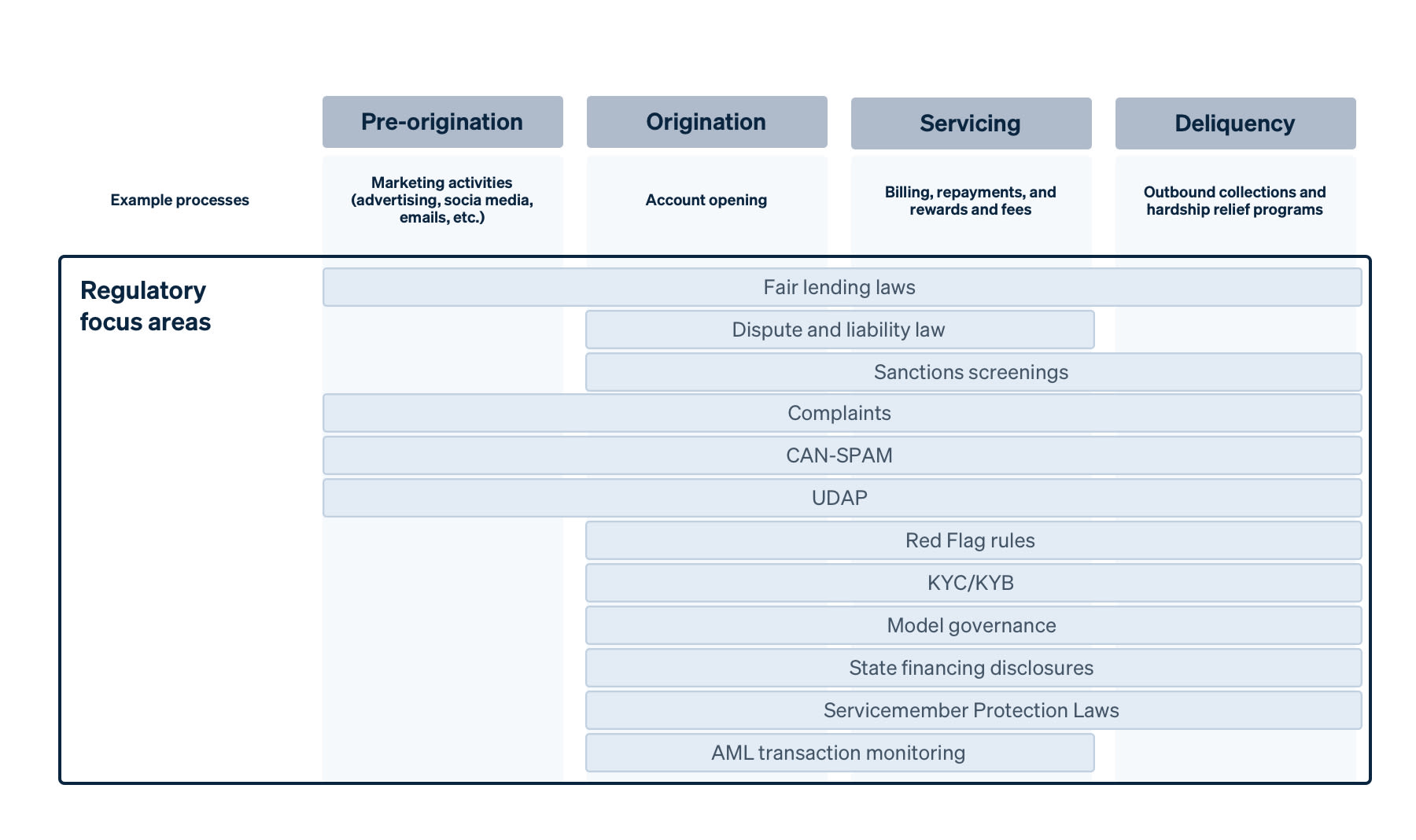
Compliance touches every aspect of a financial product, from marketing to onboarding to account closures. For example, you need to communicate all terms about a financial product (such as fees, interest, payment requirements, and other details) clearly and upfront in your marketing materials. When you are onboarding users, you must properly conduct Know Your Customer (KYC) checks and sanctions screenings, and comply with all fair lending laws if you are extending credit. And if users are delinquent on their repayment of a credit account, you may be required to comply with certain debt collection requirements that govern the frequency and times you may communicate collections reminders. And that covers just a fraction of the compliance regulations you may be required to follow.

The below diagram is for demonstrative purposes only and should not be considered an exhaustive list of fintech compliance requirements.

Common regulations 900w R3

Compliance with various regulations is essential to building a fintech: Fail to get it right, and—at best—you’ll be faced with large fines that can hurt your business. At worst, your business can be shut down.

However, ensuring compliance isn’t just about avoiding fees or legal repercussions. Investing in compliance means that your startup can create safer, more durable products for users while making money movement and financing products safe, which provides a competitive advantage for your business in the long term. In the end, you’re acting in the user’s best interest, helping them get access to a secure, stable, and beneficial product.

This guide provides an overview of how financial services in the US are regulated and what this means for your business. You’ll learn compliance fundamentals, get an overview of the most common compliance regulations, and understand your options for managing compliance for your business.

Compliance guidance and best practices

A common way to offer financial products in the US is by partnering with a bank to power your product. Each bank partner is regulated by a primary regulator (alongside a host of other regulatory bodies) that examines the bank periodically for compliance. For example, the bank may be assessed on whether it is compliant with state and federal statutes that regulate unfair and deceptive acts and practices (UDAP), which require transparent, up-front communication to customers (among other things).

Any fintech company that works with a bank is indirectly accountable to these same regulators as a result of their banking partnership. Your startup will seldom directly interact with the primary bank regulator; instead, the bank will oversee your compliance with banking-related laws and regulations. For example, using the same scenario as above, you would also be assessed by the bank on whether you remain compliant with UDAP through periodic testing engagements and reporting requirements.

Compliance fundamentals 2

In addition, federal regulators who oversee banks (and fintechs) but who do not function as a primary banking regulator include (but are not limited to):

  • The Federal Trade Commission (FTC), enforces laws against deceptive and unfair trade practices as well as unjust methods of competition. The FTC also enforces federal consumer protection laws that prevent fraud, deception, and unfair business practices. For example, the FTC may investigate telemarketing scams, sweepstakes scams, or “bogus health products.”
  • The Consumer Financial Protection Bureau (CFPB), is tasked with ensuring consumers are treated fairly by entities offering consumer financial products. It provides consumer protection across all consumer financial products, whether they’re offered by a bank, a fintech, or any other entity.

Overview of compliance regulations in the US

The specific laws and regulations you must follow greatly depend on your business. For example, certain rules only apply to consumer financial services or businesses extending credit. However, in general, there are a few rules that apply to all businesses:

Laws that apply to all financial services businesses

This section is for demonstrative purposes only and should not be considered an exhaustive list of fintech compliance requirements.

Know Your Customer (KYC) and Know Your Business (KYB) obligations

KYC or KYB is the mandatory process of verifying customer or business identities when they sign up for an account and then continually monitoring transaction patterns to gauge risk. Users must provide proof of their identity and address during your onboarding process to ensure that they are who they say they are.

What this means: Complying with KYC or KYB obligations helps ensure that the money moving through your system is safe and is not involved in money laundering, terrorism financing, or other fraudulent schemes.

Anti-money laundering (AML) rules

AML rules are a set of laws and regulations designed to prevent criminals from engaging in financial crimes and illegal activity—namely, disguising illegal funds as legitimate income. AML rules require banks and other financial service providers to record and report money movement to screen for money laundering and terrorist financing.

What this means: Helps to keep the financial system safe and secure by preventing money laundering and terrorist financing.

The Office of Foreign Assets Control (OFAC) sanctions

OFAC enforces a series of economic and trade sanctions against countries, legal entities such as businesses, and groups of individuals such as terrorists and narcotics traffickers.

What this means: Helps accomplish foreign policy and national security goals by preventing terrorism financing, money laundering, or other fraudulent schemes.

Unfair or Deceptive Acts or Practices (UDAP) and Unfair, Deceptive, and Abusive Acts or Practices (UDAAP)

UDAP and UDAAP laws prevent companies from engaging in any unfair or deceptive (and, in the case of UDAAP laws, abusive) acts or practices, such as failing to disclose fees or misrepresenting a product or service. UDAP is invoked to protect all persons and entities engaged in commerce, while UDAAP laws provide extra protection to consumers using financial products.

UDAP and UDAAP provide similar customer protections, but they differ slightly. UDAAP contains an additional, intentionally vague prohibition against “abusive” acts that is used to capture a wider variety of acts that could result in consumer harm.

What this means: Ensures that you are creating a high-quality and safe user experience by making all your communication transparent and easy to understand.

Red Flag Rules

Red Flag Rules require businesses to adopt and implement a written identity fraud program to detect the warning signs—or red flags—of identity fraud. This program helps companies more easily identify suspicious patterns and trends in their business, take appropriate steps to prevent identity theft and mitigate its damage.

What this means: Helps businesses detect fraud attempts before actual crimes are committed.

Laws that only apply to businesses that extend, support, or collect credit

Many regulations apply to businesses extending, supporting, or collecting credit. For example, you may be subject to the Fair Credit Reporting Act, the Servicemembers Civil Relief Act, the Equal Credit Opportunity Act (ECOA), and others. This guide doesn’t provide an exhaustive list of all lending laws. Instead, we’ll cover two of the most common: fair lending laws and the Truth in Lending Act.

Fair lending laws

Fair lending laws such as ECOA prohibit lenders from considering race, colour, national origin, religion, sex, familial status, or disability when applying for credit. These laws and regulations apply to any extension of credit, including credit for small businesses, corporations, and partnerships. There are also technical communication requirements within federal fair lending laws that require ​creditors to explain why an adverse action was taken against a borrower or an applicant for credit.

What this means: Prevents discrimination and ensures that people of protected classes are offered fair and equal access to credit; provides transparency to the credit underwriting process.

Truth in Lending Act (TILA)

TILA protects consumers against unfair credit billing and credit card practices. It requires lenders to provide loan cost information upfront so consumers can compare different types of loans. TILA primarily applies to consumer loans, but important fraud and dispute procedures also apply to business credit. For example, in certain situations, an employee cardholder can’t be held liable for more than $50 for the unauthorized use of a stolen credit card.

What this means: Protects borrowers from unethical lending practices and improves customer experience by ensuring that users have a clear understanding of credit costs and terms; protects certain borrowers from unauthorized use of stolen credit cards.

How to handle compliance for your business

Manage compliance yourself

Common regulations 900w R3

You or your in-house compliance team may be able to work directly with a bank to manage compliance, but it is often expensive and time-consuming. For example, this involves building a full-time compliance team from scratch, hiring lawyers, compliance experts, finance managers, and others.

To approve your in-house compliance management program, banks expect you to apply the same level of rigour that they apply to their own programs. To satisfy bank expectations, you will need to leverage your team of in-house and external legal and compliance professionals to implement and operate a resource-intensive set of program components on an ongoing basis. These components include your foundational compliance policies, risk assessment methodologies and matrices, independent testing plans and workflows, compliance training content and assessments, various compliance procedures and controls, ongoing “state of compliance” reporting, and compliance issue program management. They would evaluate you and your team for subject matter expertise, reporting capabilities, program policies, issues and risk management, internal training curriculum, and more. We recommend that you speak with a compliance professional and a lawyer to fully understand what you need to do to make this program viable.

Work with third-party advisors

Image4 ThirdParty

In addition to managing compliance by yourself, you could hire an external compliance consultant to design your policies, review materials, and test your user flows to make sure you are compliant with applicable laws.

However, not only are external consultants very expensive, but they are also compliance experts—not product experts. While they have a deep understanding of regulations, they may not be able to effectively marry that understanding with your specific product.

Offload elements of compliance to a banking-as-a-service (BaaS) solution

The below diagram represents the elements that Stripe, as the BaaS provider, oversees and/or manages, and may not apply to all BaaS providers.

Image5 Baas Oversees

A successful fintech is made up of both product excellence and compliance expertise. While third-party consultants can only advise on half of that equation (the compliance expertise), a BaaS provider can do both. A BaaS solution offers both the full suite of embedded finance needs in addition to the infrastructure for financial partnerships and compliance. This allows you to use one system for building your fintech offering, growing your feature set, and managing a compliance system, reducing the complexity required to go to market and saving internal costs.

The best BaaS offerings assign you a compliance program manager that partners directly with banks on a range of important topics including compliance, risk, reporting, marketing, disputes, and contracts—so you don’t have to.

Sometimes, your BaaS provider may build solutions directly within the product that help you adhere to the bank’s compliance requirements. For example, the best providers offer prebuilt funds flows and user onboarding elements that match the bank’s specific compliance needs and also have an in-house testing program that tests and audits your user flows on behalf of the bank.

In other cases, the compliance program manager works directly with you to outline the requirements you must adhere to, reviews and approves your entire user experience and periodically audits your compliance controls.

Even when working with a BaaS provider, your business will still be responsible for implementing certain compliance responsibilities. For example, your business will always need to ensure that all your customer-facing assets and user interfaces go through the BaaS provider’s approval process and report any user complaints to the BaaS provider (e.g., by enabling your customer service team to tag complaints so that the BaaS provider can investigate whether any are indicative of a broader compliance issue and send reports to your BaaS provider each month).

How to evaluate a BaaS provider for compliance

The best BaaS providers don’t just offer APIs to help you integrate financial services into your product—they also offer compliance as part of their product. To that end, as you’re looking for a BaaS provider, make sure to evaluate them specifically on how they help you manage compliance. For example, ask for copies of their compliance policies and sample requirements that they would ask you to implement, and compare those to other providers.

While there is no one-size-fits-all approach when evaluating a BaaS provider, we recommend asking about the following criteria during the discovery phase:

  • Relationships with multiple banking partners to ensure reliable solutions with redundancy measures.
  • Demonstrated ability to enforce compliance requirements. Ask the BaaS provider for a recent example of how they’ve modified their program to adapt to evolving compliance requirements.
  • Level of detail needed in use case supportability and onboarding. A BaaS provider that asks for more details when onboarding fintechs suggests that they have a robust compliance program.
  • The number of full-time employees working on compliance and the number of years/experience working in compliance.
  • Demonstrated ability to support multiple types of companies across industries and business models.
  • Demonstrated ability to support businesses in getting started and operating at scale (since compliance and support needs vary by company size).

Tunisie : Le rôle du switch Monétique-Tunisie dans la digitalisation de l’économie

# Le Switch Monétique-Tunisie : Pilier de la Digitalisation Économique

## Mise en place du Switch Monétique-Tunisie

Le switch monétique tunisien a été développé par la Société Monétique Tunisie (SMT), créée en 2003 sous l’impulsion de la Banque Centrale de Tunisie. Cette infrastructure nationale centralise et sécurise l’ensemble des transactions électroniques du pays.

### Architecture technique
– **Plateforme centralisée** : Hub unique pour toutes les transactions
– **Protocoles standards** : ISO 8583 pour l’interopérabilité
– **Sécurité renforcée** : Chiffrement 3DES et tokenisation
– **Haute disponibilité** : Redondance 99,9% de temps de fonctionnement

## Fonctions principales du switch

### Traitement transactionnel
– Autorisation en temps réel des paiements par carte
– Routage intelligent vers les systèmes bancaires
– Compensation et règlement interbancaire
– Gestion des rejets et réconciliations

### Services d’interopérabilité
– Connexion de 23 banques tunisiennes
– Support multi-cartes (Visa, Mastercard, cartes locales)
– Interface avec 8 000+ DAB et TPE
– Passerelle vers les réseaux internationaux

## Impact sur l’interopérabilité nationale

### Unification du paysage bancaire
Le switch a créé un écosystème unifié permettant :
– **Transactions cross-banking** : Utilisation de toute carte sur n’importe quel terminal
– **Réduction des coûts** : Mutualisation des infrastructures
– **Standardisation** : Harmonisation des processus bancaires

### Métriques d’adoption
– Volume : 180 millions de transactions/an
– Croissance : +15% annuelle depuis 2018
– Couverture : 100% des banques commerciales connectées

## Cas d’usage stratégiques

### Paiement de proximité
– **Commerce traditionnel** : TPE dans 45 000 points de vente
– **E-commerce** : Passerelle de paiement en ligne
– **Services publics** : Paiement des factures et taxes

### Innovation financière
– **Paiement mobile** : Intégration avec les wallets digitaux
– **QR Code** : Déploiement du standard EMVCo
– **Open Banking** : APIs pour les fintechs agréées

## Écosystème des parties prenantes

### Régulateurs
– **Banque Centrale de Tunisie** : Supervision et réglementation
– **Ministère des Finances** : Politique de digitalisation

### Opérateurs techniques
– **SMT** : Exploitation du switch national
– **Banques** : Émission et acquisition
– **Processeurs** : Gestion technique des cartes

### Utilisateurs finaux
– **Consommateurs** : 3,2 millions de porteurs de cartes
– **Commerçants** : 45 000 points d’acceptation
– **Administrations** : Services publics digitalisés

## Perspectives d’évolution

### Roadmap technologique 2024-2026
– Migration vers ISO 20022
– Intégration blockchain pour la traçabilité
– IA pour la détection de fraude
– APIs ouvertes pour l’écosystème fintech

### Expansion régionale
– Interconnexion avec les switches maghrébins
– Corridor de paiement Tunisie-UE
– Hub pour l’Afrique francophone

Le switch monétique tunisien constitue l’épine dorsale de la transformation digitale du secteur financier, catalysant l’inclusion financière et l’innovation technologique dans l’économie nationale.


*Source : FintechPolicies.com – Analyse des infrastructures de paiement en Afrique du Nord*

Bénin : Le switch national de paiement et la digitalisation des transactions

# Le GIM-UEMOA au Bénin : Pilier de la digitalisation des paiements

## Rôle du GIM-UEMOA au Bénin

Le Groupement Interbancaire Monétique de l’Union Économique et Monétaire Ouest Africaine (GIM-UEMOA) constitue l’infrastructure centrale du système de paiement électronique au Bénin. Cette plateforme régionale standardise et sécurise l’ensemble des transactions électroniques, permettant l’interopérabilité entre les différents acteurs financiers du pays.

Le GIM-UEMOA fonctionne comme un switch national qui interconnecte les banques, institutions de microfinance, et prestataires de services de paiement, garantissant la fluidité et la sécurité des échanges monétaires numériques sur le territoire béninois.

## Cas d’usage principaux

### Paiements marchands
– **Points de vente électroniques** : Traitement des transactions par carte bancaire dans les commerces
– **Paiements en ligne** : Sécurisation des achats sur les plateformes e-commerce
– **Facturation électronique** : Automatisation des règlements entre entreprises
– **Services publics** : Paiement des factures d’électricité, d’eau et de télécommunications

### Transferts Person-to-Person (P2P)
– **Transferts d’argent instantanés** : Envois entre particuliers via mobile money
– **Remises familiales** : Facilitation des transferts domestiques et internationaux
– **Paiements de proximité** : Règlements entre individus sans espèces
– **Épargne collaborative** : Support des tontines digitales

### Paiements Government-to-Person (G2P)
– **Salaires des fonctionnaires** : Versement automatisé des rémunérations publiques
– **Prestations sociales** : Distribution des allocations et subventions
– **Bourses d’études** : Paiement direct aux bénéficiaires
– **Programmes d’aide** : Transferts conditionnels et inconditionnels

## Impact sur l’écosystème financier

Le GIM-UEMOA catalyse l’inclusion financière au Bénin en réduisant les coûts de transaction, améliorant la traçabilité des flux monétaires et étendant l’accès aux services financiers dans les zones rurales. Cette infrastructure contribue significativement à la formalisation de l’économie béninoise.

*Pour une analyse approfondie des politiques fintech en Afrique de l’Ouest, consultez FintechPolicies.com*

L’écosystème fintech au Togo : innovation au service de l’inclusion

# L’écosystème fintech au Togo : innovation au service de l’inclusion

## Les fintech togolaises en pleine expansion

Le Togo connaît une transformation numérique remarquable de son secteur financier. Les entreprises fintech locales se multiplient et proposent des solutions innovantes adaptées aux besoins spécifiques du marché togolais. Ces acteurs émergents développent des plateformes de crédit numérique, des services d’épargne digitale et des solutions de gestion financière pour les PME et les particuliers.

Les startups comme Wari, présente dans plusieurs pays africains, et d’autres acteurs locaux contribuent à démocratiser l’accès aux services financiers. Ces entreprises exploitent les technologies blockchain, l’intelligence artificielle et l’analyse de données pour créer des produits financiers plus accessibles et moins coûteux.

## Services de mobile money : révolution des paiements

Le mobile money constitue l’épine dorsale de l’inclusion financière au Togo. Les opérateurs télécoms proposent des services de portefeuille électronique qui permettent aux populations, notamment rurales, d’accéder aux services financiers de base sans compte bancaire traditionnel.

Ces services incluent :
– Transferts d’argent nationaux et internationaux
– Paiement de factures et services publics
– Épargne mobile
– Micro-crédit instantané
– Paiements marchands

L’adoption massive du mobile money a créé un écosystème dynamique où commerçants, particuliers et institutions peuvent effectuer des transactions sécurisées via leurs téléphones portables.

## Paiements digitaux : vers une économie cashless

Les solutions de paiement digital se diversifient au Togo avec l’émergence de cartes prépayées, de QR codes et de plateformes de paiement en ligne. Les banques traditionnelles collaborent avec les fintech pour proposer des services hybrides combinant expertise bancaire et innovation technologique.

Les paiements digitaux facilitent le commerce électronique naissant et permettent aux entreprises d’optimiser leur gestion de trésorerie. Cette digitalisation contribue également à l’amélioration de la traçabilité des transactions et à la formalisation de l’économie.

## Intégration avec GIM-UEMOA

Le Groupement Interbancaire Monétique de l’Union Économique et Monétaire Ouest Africaine (GIM-UEMOA) joue un rôle central dans l’harmonisation des systèmes de paiement régionaux. Cette plateforme permet l’interopérabilité des services financiers digitaux entre les pays membres, facilitant les échanges commerciaux et les transferts de fonds transfrontaliers.

L’intégration du Togo dans ce système régional renforce la connectivité financière et offre aux utilisateurs togolais un accès élargi aux services financiers dans l’ensemble de la zone UEMOA. Cette harmonisation favorise également l’émergence de solutions fintech à dimension régionale.

## Perspectives d’avenir

L’écosystème fintech togolais continue d’évoluer avec le soutien des autorités réglementaires qui adaptent le cadre juridique pour encourager l’innovation tout en préservant la stabilité financière. Cette dynamique positionne le Togo comme un hub fintech prometteur en Afrique de l’Ouest.

Pour une analyse approfondie des politiques fintech et des tendances réglementaires dans la région, consultez FintechPolicies.com.

A simple guide to PCI compliance

Payment Card Industry Data Security Standards (PCI DSS) sets the minimum standard for data security. Here’s a step-by-step guide to maintaining compliance.

Since 2005, over 11 billion consumer records have been compromised from over 8,500 data breaches. These are the latest numbers from The Privacy Rights Clearinghouse, which reports on data breaches and security breaches impacting consumers dating back to 2005.

To improve the safety of consumer data and trust in the payment ecosystem, a minimum standard for data security was created. Visa, Mastercard, American Express, Discover, and JCB formed the Payment Card Industry Security Standards Council (PCI SSC) in 2006 to administer and manage security standards for companies that handle credit card data. Before the PCI SSC was established, these five credit card companies all had their own security standards programs—each with roughly similar requirements and goals. They banded together through the PCI SSC to align on one standard policy, the PCI Data Security Standards (known as PCI DSS) to ensure a baseline level of protection for consumers and banks in the internet era.

Understanding PCI DSS can be complex and challenging

If your business model requires you to handle card data, you may be required to meet each of the 300+ security controls in PCI DSS. There are more than 1,800 pages of official documentation, published by the PCI Council, about PCI DSS, and more than 300 pages just to understand which form(s) to use when validating compliance. This would take over 72 hours just to read.

To ease this burden, the following is a step-by-step guide to validating and maintaining PCI compliance.

Overview of PCI Data Security Standard (PCI DSS)

PCI DSS is the global security standard for all entities that store, process, or transmit cardholder data and/or sensitive authentication data. PCI DSS sets a baseline level of protection for consumers and helps reduce fraud and data breaches across the entire payment ecosystem. It applies to any organization that accepts or processes payment cards.

PCI DSS compliance involves three main components:

  1. Handling the ingress of credit card data from customers; namely, that sensitive card details are collected and transmitted securely
  2. Storing data securely, which is outlined in the 12 security domains of the PCI standard, such as encryption, ongoing monitoring, and security testing of access to card data
  3. Validating annually that the required security controls are in place, which can include forms, questionnaires, external vulnerability scanning services, and third-party audits (see the step-by-step guide below for a table with the four levels of requirements)

Handling card data

Some business models do require the direct handling of sensitive credit card data when accepting payments, while others do not. Companies that do need to handle card data (e.g., accepting untokenized PANs on a payment page) may be required to meet each of the 300+ security controls in PCI DSS. Even if card data only traverses its servers for a short moment, the company would need to purchase, implement, and maintain security software and hardware.

If a company does not need to handle sensitive credit card data, it shouldn’t. Third-party solutions securely accept and store the data, whisking away considerable complexity, cost, and risk. Since card data never touches its servers, the company would only need to confirm 22 security controls, most of which are straightforward, such as using strong passwords.

Storing data securely

If an organization handles or stores credit card data, it needs to define the scope of its cardholder data environment (CDE). PCI DSS defines CDE as the people, processes, and technologies that store, process, or transmit credit card data—or any system connected to it. Since all 300+ security requirements in PCI DSS apply to CDE, it’s important to properly segment the payment environment from the rest of the business to limit the scope of PCI validation. If an organization is unable to contain the CDE scope with granular segmentation, the PCI security controls would then apply to every system, laptop, and device on its corporate network…

Annual validation

Regardless of how card data is accepted, organizations are required to complete a PCI validation form annually. The way PCI compliance is validated depends on several factors, which are outlined below. Here are three scenarios in which an organization could be asked to show that it is PCI compliant:

  • Payment processors may request it as part of their required reporting to the payment card brands.
  • Business partners may request it as a prerequisite to entering into business agreements.
  • For platform businesses (those whose technology facilitates online transactions among multiple distinct sets of users), customers may request it to show their customers that they are handling data securely.

The latest set of security standards, PCI DSS version 3.2.1, includes 12 main requirements with more than 300 sub-requirements that mirror security best practices.

BUILD AND MAINTAIN A SECURE NETWORK AND SYSTEMS

  • 1. Install and maintain a firewall configuration to protect cardholder data.
  • 2. Do not use vendor-supplied defaults for system passwords and other security parameters.

PROTECT CARDHOLDER DATA

  • 3. Protect stored cardholder data.
  • 4. Encrypt transmission of cardholder data across open or public networks.

MAINTAIN A VULNERABILITY MANAGEMENT PROGRAM

  • 5. Protect all systems against malware and regularly update anti-virus software.
  • 6. Develop and maintain secure systems and applications.

IMPLEMENT STRONG ACCESS CONTROL MEASURES

  • 7. Restrict access to cardholder data by business need to know.
  • 8. Identify and authenticate access to system components.
  • 9. Restrict physical access to cardholder data.

REGULARLY MONITOR AND TEST NETWORKS

  • 10. Track and monitor all access to network resources and cardholder data.
  • 11. Regularly test security systems and processes.

MAINTAIN AN INFORMATION SECURITY POLICY

  • 12. Maintain a policy that addresses information security for all personnel.

To make it “easier” for new businesses to validate PCI compliance, the PCI Council created nine different forms or Self-Assessment Questionnaires (SAQs) that are a subset of the entire PCI DSS requirement. The trick is figuring out which is applicable or whether it’s necessary to hire a PCI Council–approved auditor to verify that each PCI DSS security requirement has been met. In addition, the PCI Council revises the rules every three years and releases incremental updates throughout the year, adding even more dynamic complexity.

A step-by-step guide to PCI DSS v3.2.1 compliance

1. Know your requirements

The first step in achieving PCI compliance is knowing which requirements apply to your organization. There are four different PCI compliance levels, typically based on the volume of credit card transactions your business processes during 12 months.

Compliance level

Applies to

Requirements

Level 1

  1. Organizations that annually process more than 6 million transactions of Visa or Mastercard, or more than 2.5 million for American Express; or
  2. Have experienced a data breach; or
  3. Are deemed “Level 1” by any card association (Visa, Mastercard, etc.)

  1. Annual Report on Compliance (ROC) by a Qualified Security Assessor (QSA)—also commonly known as a Level 1 onsite assessment—or internal auditor if signed by an officer of the company
  2. Quarterly network scan by Approved Scan Vendor (ASV)
  3. Attestation of Compliance (AOC) for Onsite Assessments–there are specific forms for merchants and service providers

Level 2
Organizations that process between 1–6 million transactions annually

  1. Annual PCI DSS Self-Assessment Questionnaire (SAQ)—there are 9 SAQ types shown briefly in the table below
  2. Quarterly network scan by Approved Scan Vendor (ASV)
  3. Attestation of Compliance (AOC)—each of the 9 SAQs has a respective AOC form

Level 3

  1. Organizations that process between 20,000–1 million online transactions annually
  2. Organizations that process fewer than 1 million total transactions annually
Same as above

Level 4

  1. Organizations that process fewer than 20,000 online transactions annually; or
  2. Organizations that process up to 1 million total transactions annually
Same as above

For Levels 2–4, there are different SAQ types depending on your payment integration method. Here’s a brief table:

SAQ

Description

A

Card-not-present merchants (ecommerce or mail/telephone-order) that have fully outsourced all cardholder data functions to PCI DSS–compliant third-party service providers, with no electronic storage, processing, or transmission of any cardholder data on the merchant’s systems or premises.

Not applicable to face-to-face channels.

A-EP

Ecommerce merchants who outsource all payment processing to PCI DSS–validated third parties, and who have a website(s) that doesn’t directly receive cardholder data but that can impact the security of the payment transaction. No electronic storage, processing, or transmission of cardholder data on merchant’s systems or premises.

Applicable only to e-commerce channels.

B

Merchants using only:

  • Imprint machines with no electronic cardholder data storage, and/or
  • Standalone, dial-out terminals with no electronic cardholder data storage.

Not applicable to e-commerce channels.

B-IP

Merchants using only standalone, PTS-approved payment terminals with an IP connection to the payment processor with no electronic cardholder data storage.

Not applicable to e-commerce channels.

C-VT

Merchants who manually enter a single transaction at a time via a keyboard into an internet-based, virtual payment terminal solution that is provided and hosted by a PCI DSS–validated third-party service provider. No electronic cardholder data storage.

Not applicable to e-commerce channels.

C

Merchants with payment application systems connected to the Internet, no electronic cardholder data storage.

Not applicable to e-commerce channels.

P2PE

Merchants using only hardware payment terminals included in and managed via a validated, PCI SSC–listed point-to-point Encryption (P2PE) solution, with no electronic cardholder data storage.

Not applicable to e-commerce channels.

D

SAQ D FOR MERCHANTS: All merchants are not included in descriptions for the above SAQ types.

SAQ D FOR SERVICE PROVIDERS: All service providers defined by a payment brand as eligible to complete an SAQ.

2. Map your data flows

Before you can protect sensitive credit card data, you need to know where it lives and how it gets there. You’ll want to create a comprehensive map of the systems, network connections, and applications that interact with credit card data across your organization. Depending on your role, you’ll probably need to work with your IT and security team(s) to do this.

  • First, identify every consumer-facing area of the business that involves payment transactions. For example, you may accept payments via an online shopping cart, in-store payment terminals, or orders placed over the phone.
  • Next, pinpoint the various ways cardholder data is handled throughout the business. It’s important to know exactly where the data is stored and who has access to it.
  • Then, identify the internal systems or underlying technologies that touch payment transactions. This includes your network systems, data centers, and cloud environments.

3. Check security controls and protocols

Once you map out all the potential touchpoints for credit card data across your organization, work with IT and security teams to ensure the right security configurations and protocols are in place (see the list of 12 security requirements for PCI DSS above). These protocols are designed to secure the transmission of data, like Transport Layer Security (TLS).

The 12 security requirements for PCI DSS v3.2.1 stem from best practices for protecting sensitive data for any business. Several overlap with those required to meet GDPR, HIPAA, and other privacy mandates, so a few of them may already be in place in your organization.

4. Monitor and maintain

It’s important to note that PCI compliance is not a one-time event. It’s an ongoing process to ensure your business remains compliant even as data flows and customer touchpoints evolve. Some credit card brands may require you to submit quarterly or annual reports, or complete an annual on-site assessment to validate ongoing compliance, particularly if you process more than 6 million transactions each year.

Managing PCI compliance throughout the year (and year over year) often requires cross-departmental support and collaboration. If this doesn’t already exist, it may be worthwhile to create a dedicated team internally to properly maintain compliance. While every company is unique, a good starting point for a “PCI team” would include representation from the following:

  • Security: The Chief Security Officer (CSO), Chief Information Security Officer (CISO), and their teams ensure the organization is always properly investing in the necessary data security and privacy resources and policies.
  • Technology/Payments: The Chief Technology Officer (CTO), VP of Payments, and their teams make sure that core tools, integrations, and infrastructure remain compliant as the organization’s systems evolve.
  • Finance: The Chief Financial Officer (CFO) and their team ensure that all payment data flows are accounted for when it comes to payment systems and partners.
  • Legal: This team can help navigate the many legal nuances of PCI DSS compliance.

For more information about the complex world of PCI compliance, head to the PCI Security Standards Council website. If you only read this guide and a few other PCI docs, we recommend starting with these: prioritized approach for PCI DSS, SAQ instructions and guidelines, FAQ about using SAQ eligibility criteria to determine onsite assessment requirements, and FAQ about obligations for merchants that develop apps for consumer devices that accept payment card data.

Conclusion

Assessing and validating PCI compliance usually happens once a year, but PCI compliance is not a one-time event—it’s a continuous and substantial effort of assessment and remediation. As a company grows so will the core business logic and processes, which means compliance requirements will evolve as well. An online business, for example, may decide to open physical stores, enter new markets, or launch a customer support center. If anything new involves payment card data, it’s a good idea to proactively check whether this has any impact on your PCI validation method and re-validate PCI compliance as necessary.

L’écosystème fintech au Burkina Faso : défis et opportunités

# L’écosystème fintech au Burkina Faso : défis et opportunités

## Les fintech locales : un paysage en développement

Le Burkina Faso compte plusieurs acteurs fintech émergents qui transforment progressivement le secteur financier national. Parmi les principales entreprises locales, on retrouve :

– **Orange Money** et **Moov Money** qui dominent le marché des services financiers mobiles
– **Coris Bank** avec ses solutions digitales innovantes
– **Ecobank** et ses plateformes de banque numérique
– Des startups locales comme **Djanta** et **PayDunya** qui développent des solutions de paiement adaptées au contexte burkinabè

Ces acteurs proposent des services variés : transferts d’argent, paiements marchands, épargne mobile, microcrédits et solutions de bancarisation des populations non bancarisées.

## Adoption du mobile money : une révolution en marche

L’adoption du mobile money au Burkina Faso connaît une croissance remarquable :

### Statistiques clés
– Plus de 8 millions d’utilisateurs de services financiers mobiles
– Taux de pénétration supérieur à 40% de la population adulte
– Volume de transactions en augmentation de 25% annuellement
– Concentration urbaine avec extension progressive vers les zones rurales

### Facteurs d’adoption
– **Inclusion financière** : 70% de la population reste non bancarisée
– **Infrastructure mobile** : couverture réseau en amélioration constante
– **Simplicité d’usage** : interfaces adaptées aux utilisateurs peu alphabétisés
– **Coûts réduits** : frais de transaction compétitifs par rapport aux banques traditionnelles

### Défis persistants
– Faible taux d’alphabétisation numérique
– Infrastructure internet limitée en zones rurales
– Méfiance envers les services financiers digitaux
– Interopérabilité limitée entre opérateurs

## Cadre réglementaire : entre innovation et prudence

### Régulation actuelle
La Banque Centrale des États de l’Afrique de l’Ouest (BCEAO) supervise l’écosystème fintech burkinabè à travers :

– **Instruction n°008-05-2015** régissant les services de paiement par mobile
– **Loi bancaire UEMOA** adaptée aux nouveaux services financiers
– **Dispositif de surveillance** des établissements de monnaie électronique
– **Cadre prudentiel** pour les institutions de microfinance digitales

### Défis réglementaires
– Équilibre entre innovation et protection des consommateurs
– Harmonisation des règles au niveau sous-régional
– Adaptation rapide aux évolutions technologiques
– Renforcement de la cybersécurité

## Le rôle stratégique du GIM-UEMOA

Le Groupement Interbancaire Monétique de l’Union Économique et Monétaire Ouest Africaine (GIM-UEMOA) joue un rôle central dans le développement de l’écosystème fintech burkinabè :

### Missions principales
– **Interopérabilité** : facilitation des transactions entre différents systèmes de paiement
– **Standardisation** : harmonisation des protocoles techniques et sécuritaires
– **Infrastructure partagée** : développement de plateformes communes
– **Formation** : renforcement des capacités des acteurs locaux

### Impact sur l’écosystème
– Réduction des coûts de transaction inter-opérateurs
– Amélioration de la sécurité des paiements électroniques
– Facilitation des transferts transfrontaliers
– Promotion de l’inclusion financière régionale

### Projets structurants
– Plateforme d’interopérabilité des services de paiement mobile
– Système de compensation électronique régional
– Standards de sécurité harmonisés
– Programmes de certification des prestataires

## Opportunités et perspectives d’avenir

### Secteurs porteurs
– **AgriTech** : financement et assurance agricoles
– **Commerce électronique** : solutions de paiement en ligne
– **Microfinance digitale** : crédit scoring et prêts automatisés
– **Assurance mobile** : produits d’assurance simplifiés

### Facteurs de croissance
– Démographie jeune et connectée
– Croissance économique soutenue
– Politiques gouvernementales favorables
– Investissements étrangers croissants

### Défis à relever
– Renforcement de l’infrastructure technologique
– Amélioration de l’éducation financière
– Développement des compétences locales
– Attraction des investissements

## Conclusion

L’écosystème fintech burkinabè présente un potentiel considérable malgré les défis structurels. L’adoption croissante du mobile money, soutenue par un cadre réglementaire en évolution et l’action du GIM-UEMOA, ouvre des perspectives prometteuses pour l’inclusion financière et le développement économique. Le succès de cette transformation dépendra de la capacité des acteurs à collaborer efficacement et à adapter leurs solutions aux besoins spécifiques de la population burkinabè.

Pour des analyses approfondies sur les politiques fintech en Afrique de l’Ouest et leurs impacts, consultez **FintechPolicies.com**.

L’écosystème fintech au Maroc : startups, régulation et opportunités de croissance

# L’écosystème fintech au Maroc : startups, régulation et opportunités de croissance

## Vue d’ensemble de l’écosystème fintech marocain

L’écosystème fintech marocain connaît une croissance dynamique, porté par une stratégie nationale de digitalisation et un cadre réglementaire progressiste. Le Maroc s’impose comme un hub fintech régional avec des initiatives gouvernementales ambitieuses et un écosystème entrepreneurial en pleine expansion.

## Acteurs bancaires traditionnels

### Banques leaders dans la transformation digitale

**Attijariwafa Bank** : Premier groupe bancaire marocain, pionnier dans les services bancaires digitaux avec sa plateforme “Attijari Mobile” et ses solutions de paiement innovantes.

**Banque Populaire du Maroc** : Développe activement ses services numériques à travers “Chaabi Mobile” et investit dans les technologies blockchain et IA.

**BMCE Bank of Africa** : Forte présence continentale, leader dans les solutions de paiement transfrontalières et les services bancaires mobiles.

**Crédit du Maroc** : Mise sur l’innovation avec des partenariats fintech et le développement de solutions de banque ouverte.

**Société Générale Maroc** : Intègre les technologies fintech dans ses processus avec des solutions de crédit digital et de gestion patrimoniale automatisée.

## Opérateurs télécoms et services financiers mobiles

### Maroc Telecom (Inwi)
– **Inwi Money** : Plateforme de mobile money permettant transferts, paiements et services financiers de base
– Partenariats avec institutions financières pour l’inclusion financière

### Orange Maroc
– **Orange Money** : Service de paiement mobile avec écosystème étendu de marchands
– Solutions B2B pour entreprises et administrations

### Meditel (devenu Orange)
– Intégration progressive dans l’écosystème Orange Money
– Focus sur les zones rurales et périurbaines

## Startups fintech locales émergentes

### Paiements et wallets digitaux
**PayTech** : Startup spécialisée dans les solutions de paiement pour e-commerce et services financiers digitaux.

**WafaCash** : Filiale d’Attijariwafa Bank, leader dans les transferts d’argent et services de paiement.

**CashPlus** : Réseau de distribution de services financiers avec digitalisation progressive.

### Lending et crédit digital
**Creditech** : Plateforme de crédit participatif et financement alternatif pour PME.

**Lendtech Morocco** : Solutions de micro-crédit digital avec scoring algorithmique.

### Blockchain et crypto
**Blockchain Morocco** : Développement de solutions blockchain pour services financiers et traçabilité.

## Segments clés de la fintech marocaine

### Mobile Money et Wallets
– **Adoption croissante** : Plus de 8 millions d’utilisateurs de services de mobile money
– **Cas d’usage** : Transferts P2P, paiement factures, recharge téléphonique
– **Défis** : Interopérabilité entre opérateurs et inclusion des populations rurales

### Lending et Financement Alternatif
– **Crowdfunding** : Émergence de plateformes de financement participatif
– **Crédit digital** : Scoring basé sur données alternatives (télécom, comportementales)
– **Microfinance digitale** : Digitalisation des institutions de microfinance traditionnelles

### Insurtech
– **Assurance paramétrique** : Solutions pour agriculture et risques climatiques
– **Micro-assurance** : Produits accessibles via mobile money
– **Insurtech B2B** : Plateformes de gestion et distribution pour assureurs

### RegTech et Compliance
– **KYC digital** : Solutions d’identification et vérification clients
– **AML/CFT** : Outils de détection de blanchiment et financement terrorisme
– **Reporting réglementaire** : Automatisation des déclarations aux autorités

## Rôle du switch CMI dans l’interopérabilité

### Centre Monétique Interbancaire (CMI)
Le CMI joue un rôle central dans l’écosystème de paiement marocain :

**Infrastructure technique** :
– Switch national pour transactions par cartes bancaires
– Interconnexion de tous les réseaux bancaires
– Traitement de plus de 200 millions de transactions annuelles

**Facilitation de l’interopérabilité** :
– Standardisation des protocoles de communication
– Certification des solutions de paiement
– Passerelle entre banques et fintechs

**Innovation et développement** :
– Support aux nouvelles technologies (contactless, mobile payment)
– Intégration des wallets digitaux dans l’écosystème
– Développement de l’Open Banking

**Impact sur l’écosystème fintech** :
– Réduction des barrières techniques pour les startups
– Accélération du time-to-market pour nouveaux services
– Harmonisation des standards de sécurité

## Cadre réglementaire et supervision

### Bank Al-Maghrib (Banque Centrale)
– **Stratégie nationale de paiement** : Feuille de route pour digitalisation
– **Regulatory sandbox** : Environnement de test pour innovations fintech
– **Directives sur mobile money** : Cadre pour services de paiement mobile

### AMMC (Autorité Marocaine du Marché des Capitaux)
– Régulation du crowdfunding et financement participatif
– Supervision des plateformes de trading et investissement

## Opportunités de croissance

### Inclusion financière
– **Population non bancarisée** : 29% des adultes sans compte bancaire
– **Zones rurales** : Potentiel important pour services mobiles
– **Segments jeunes** : Adoption naturelle des solutions digitales

### Transformation digitale des entreprises
– **PME** : Besoins en solutions de paiement et financement
– **E-commerce** : Croissance du commerce électronique post-COVID
– **Administration** : Digitalisation des services publics

### Expansion régionale
– **Afrique de l’Ouest** : Positionnement comme hub fintech
– **Corridor migratoire** : Services de transferts d’argent
– **Partenariats internationaux** : Attraction d’investisseurs étrangers

### Technologies émergentes
– **Intelligence artificielle** : Scoring crédit et détection fraude
– **Blockchain** : Traçabilité et smart contracts
– **IoT** : Assurance connectée et paiements automatisés

## Défis et perspectives

### Défis structurels
– Interopérabilité entre systèmes de paiement
– Éducation financière des populations
– Cybersécurité et protection des données

### Perspectives d’évolution
– Accélération de l’adoption post-pandémie
– Émergence de licornes fintech marocaines
– Renforcement du positionnement régional

L’écosystème fintech marocain présente un potentiel de croissance exceptionnel, soutenu par une vision stratégique claire, un cadre réglementaire adaptatif et une infrastructure technique robuste incarnée par le switch CMI. Les opportunités d’innovation et d’expansion restent considérables dans un marché en pleine transformation digitale.

**FintechPolicies.com est un cabinet de conseil spécialisé en fintech et technologies de paiement.**